Pristine Blue. Copper, chemistry, and a two-week calendar.
Some folks want a pool they fuss over every evening. Other folks want a pool that mostly minds its own business. Pristine Blue is built for the second crowd: a copper-based algaecide you top off on a two-week cycle, plus a small cast of companion bottles that each have one job.
This is the full tour: what the blue stuff actually is, what it is not, how to start it, how to keep it, how to test it, and what to do when the water starts acting dramatic. Every dose on this page comes straight from Pristine Blue’s own label and care guide. If it isn’t printed there, it isn’t printed here.
By Ryan Musch
Director of Liquid Affairs, The Fin
POOL SCHOOL · PRISTINE BLUE EDITION
What this story covers. The Pristine Blue® Pool & Spa Care System for residential pools, spas, hot tubs, and swim spas: the active ingredient, the companion products, start-up and conversions, the two-week maintenance cycle, copper testing, winterizing, and troubleshooting. No prices. Doses are quoted from the manufacturer; your bottle’s label always wins.
“Copper keeps the algae humble. The chart keeps you honest.”
— Ryan Musch, The Fin · authored for this page
THE GENERAL EDUCATION · WHAT’S ACTUALLY IN THE BOTTLE
It’s copper. In a very nice outfit.
Pristine Blue is the cornerstone of a whole system, but the blue bottle itself is simple. Here’s what the label and care guide say, minus the marketing confetti.
THE ACTIVE INGREDIENT
Liquid copper, measured in ppm.
The active ingredient is copper sulfate pentahydrate (19.8%), which works out to 5% metallic copper. It’s registered as an algicide and a bactericide for nonpublic health bacteria, including bacteria that cause odor problems. Dosed by the label, it brings your water to 0.9 ppm metallic copper. The label’s ceiling is 1.0 ppm. The care guide adds that it’s NSF/ANSI/CAN 60 certified and gentle on pumps, filters, and automatic cleaners.
THE FIN TAKEThink of copper as the bouncer who keeps algae from getting in. It works best when it’s on duty before the party starts. The label says to apply before visible algae appear.
THE PLOT TWIST
It is not a solo act.
People call Pristine Blue “chlorine-free.” The manufacturer is more careful: its care guide says Pristine Blue is not a primary disinfectant, and that where multiple swimmers are present, you should pair it with one. In the system, that partner is PristineExtra2, which is 99% sodium dichlor (granular chlorine) and which the brand calls “a primary sanitizer.” The win is less fuss and a two-week rhythm, not zero chlorine.
THE FIN TAKECopper handles the algae. The shock handles the gunk people bring in. You need both on the team.
PLAYS WELL WITH
More friends than you’d think.
Chlorine and bromine: compatible, per the manufacturer.
Salt chlorine generators: compatible. Turn the salt system down to its lowest setting, then follow the start-up steps.
Ozone and UV: compatible.
Filters: sand, D.E., glass, and cartridge all work.
Surfaces: the brand says all pool surfaces. One exception: wait on brand-new or resurfaced plaster until your contractor says it’s fully cured.
DEFINITELY DO NOT
The four-item “nope” list.
Other algaecides. They’re unnecessary, and many contain copper, which could push you into an overdose.
Copper or copper/silver ionizers. Remove or bypass them first. Two copper sources is one too many.
Biguanides (Baquacil®, SoftSwim®). Converting takes a careful, multi-step process (see Start-up).
Metal removers (products that pull iron and other metals out of the water). The manufacturer says to call them first.
THE SUPPORTING CAST · ONE BOTTLE, ONE JOB
Meet the family. Everybody has a job.
The system names are cute, but they’re easy to mix up at 7 p.m. with a flashlight in your teeth. Here’s the cheat sheet, in the manufacturer’s own words, translated.
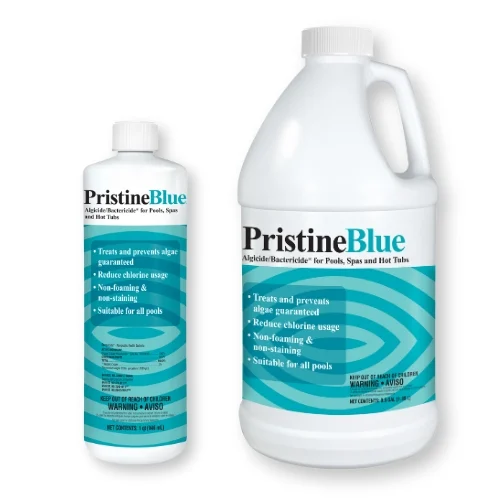
PristineBlue®
ALGAECIDE / BACTERICIDE*
The cornerstone. Added at start-up and topped off every two weeks to hold the copper level.
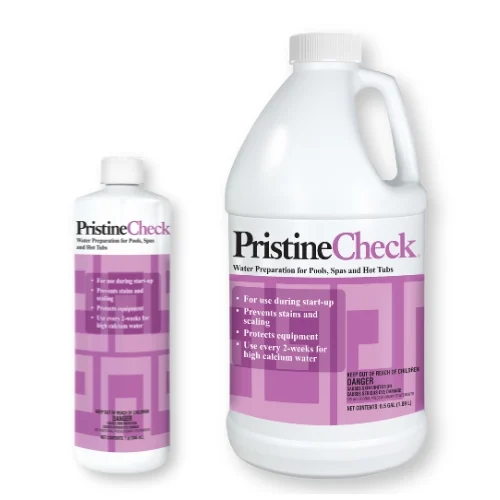
PristineCheck®
WATER PREP
Added before PristineBlue to sequester calcium and other minerals. Also used at maintenance when calcium hardness runs high.
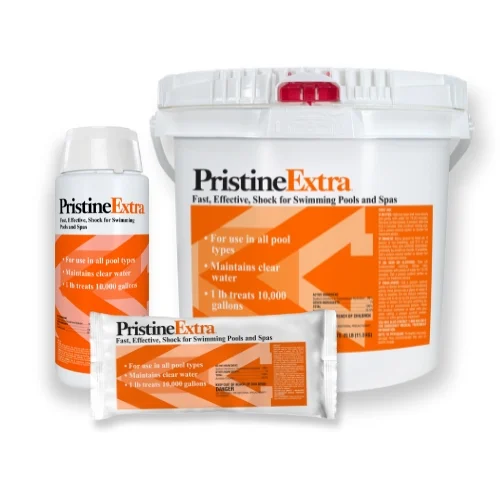
PristineExtra2®
CHLORINE SHOCK
99% sodium dichlor. The primary sanitizer of the system, used at start-up, at maintenance, and for troubleshooting.
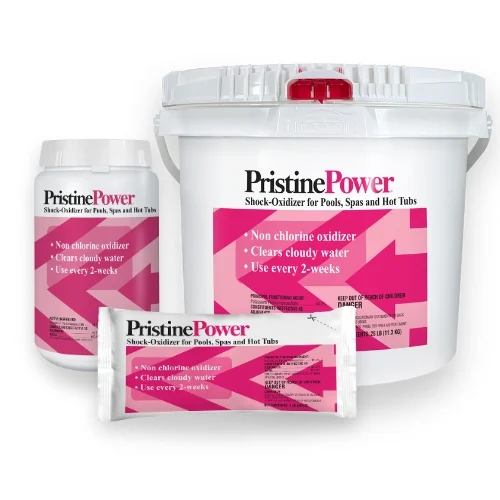
PristinePower®
NON-CHLORINE OXIDIZER
Potassium monopersulfate. Oxidizes the organic contaminants that make water cloudy. Contains no chlorine.
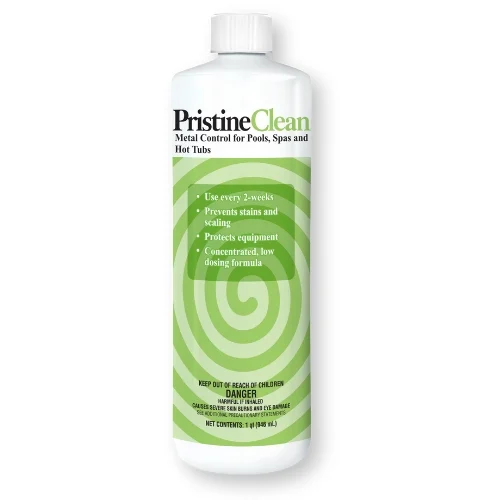
PristineClean®
SCALE & METAL INHIBITOR
Keeps metal and mineral particles from bonding to walls and other surfaces. Also the brand’s pick against “swimmer’s hair.”
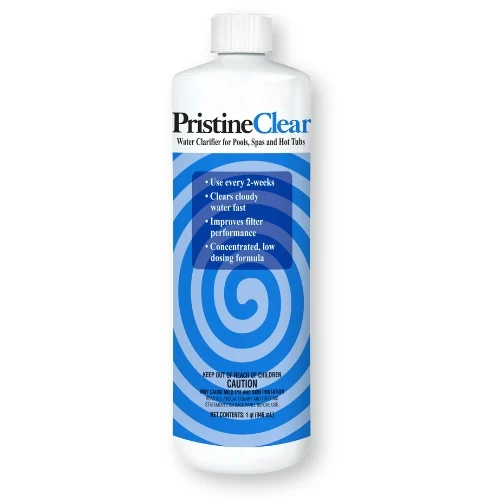
PristineClear®
CLARIFIER
Pulls suspended particles together so your filter can actually catch them. Cloudy water’s least favorite bottle.
EnzyPure™
ENZYME CLARIFIER
Plant-based enzymes that eat body oils, lotions, and cosmetics. The brand suggests it instead of PristineClear when oils are the problem. Use one or the other at maintenance, not both.
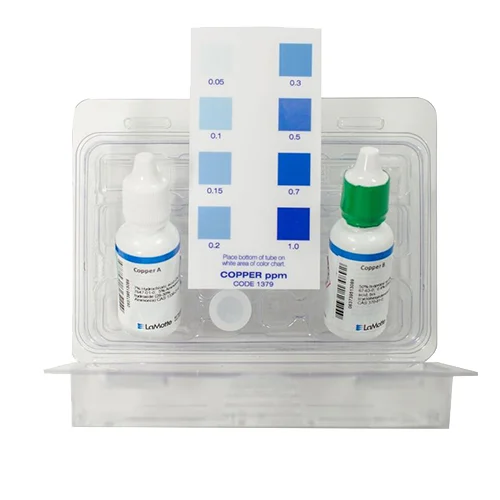
Test kit & strips
YOUR EYES
The Mini Test Kit™ measures the PristineBlue (copper) level. PristineStrips™ check total alkalinity and pH. There are also a Start-Up Kit™ for pools and a Spa Kit™ for spas.
*Bactericide for nonpublic health bacteria. Product photos are official PristineBlue images from pristineblue.com.
START-UP · BALANCE, PREP, BLUE
Start it right. Balance, prep, then blue.
Every Pristine Blue start-up follows the same rhythm (the brand says switching from chlorine or bromine takes less than 48 hours): balance the water, prep it, then add the blue. Before any of it, the manufacturer wants three things: an accurate water volume, a clean pool or spa with working equipment, and a test of your source water (especially well water). That last one is where we come in. Bring us a sample of the water you’ll fill with.
TOTAL ALKALINITY50–90 ppm
pH7.2–7.6
CALCIUM HARDNESS100–400 ppm
These are Pristine Blue’s own target ranges, for pools and spas alike. Adjust alkalinity before pH, and let the water circulate 4 hours after any pH or alkalinity product before you retest.
POOLS · SPRING OPENING OR FRESH FILL
Pool start-up
Clean the pool, vacuum, and clean or backwash the filter. Run the filter continuously through start-up.
Balance to the ranges above. It may take a few days. Be patient.
Prep: add 2 oz PristineCheck per 1,000 gal and run the filter 6 hours. Then add 1 lb PristineExtra2 per 10,000 gal and keep the pump running at least 12 hours. Backwash or clean the cartridge.
Blue: new users add 2 oz PristineBlue per 1,000 gal. Spring openings and current users test the copper first and dose from the chart.
THE FIN TAKEWas the pool green going in? The brand says you may need PristineExtra2 daily until it clears. Copper is a bouncer, not a hazmat crew.
SPAS, HOT TUBS & SWIM SPAS
Spa start-up
Clear debris, and replace or thoroughly clean the filter.
Balance to the same ranges above.
Prep: spas and hot tubs get 10 mL PristineCheck per 100 gal, then 5 mL PristineExtra2 per 100 gal, circulating 2–4 hours after each. Swim spas get 2 oz of each per 1,000 gal.
Blue: spas and hot tubs get 6 mL PristineBlue per 100 gal, then run the filter 1 hour. Swim spas get 2 oz per 1,000 gal, then circulate 2–4 hours.
THE FIN TAKESpa doses are in milliliters and pool doses are in ounces. Use the cup that came with the bottle. A kitchen “splash” is not a unit.
MAINTENANCE · EVERY 14 DAYS, LIKE A DENTIST BUT FUN
The two-week routine. Then you relax.
Clean the filter first (clean the cartridge, backwash the sand, or bump the D.E. based on the pressure gauge), so you’re not feeding fresh chemicals to yesterday’s dirt. Wait 15 minutes between products. In pools, pour at opposite ends, near a return, away from the skimmer. If you can, add PristineExtra2 after sunset and everything else the next morning, so the sun doesn’t burn off your shock.
POOLS · PER 10,000 GALLONS
Pool cycle
Balance: test, then adjust to the target ranges.
Shock: 1 lb PristineExtra2. You may need it as often as weekly after heavy swimming or heavy rain.
Protect: 2 oz PristineClean.
Clarify: 2 oz PristineClear or 4 oz EnzyPure.
Blue: test the copper and add only what the chart says.
SPAS & HOT TUBS · PER 100 GALLONS
Spa cycle
Balance: test, then adjust.
Protect: 1 mL PristineClean (swim spas: 10 mL per 1,000 gal).
Shock: 5 mL PristineExtra2 or PristinePower as needed (swim spas: 2 oz per 1,000 gal).
Clarify: 2 mL PristineClear or 2 mL EnzyPure.
Blue: test the copper and dose from the spa chart.
THE FIN TAKEAfter each day of soaking, the brand says to add 5 mL PristineExtra2 (keeping chlorine at no more than 1–5 ppm) or PristinePower per 100 gal, no more than once a day. Swim spas get 2 oz per 1,000 gal.
TESTING · THE CHART DOES THE MATH
Test the copper. Then read the chart.
Every 14 days, test the copper with a standard pool copper test (the PristineBlue Mini Test Kit does exactly this). The goal is 0.9 ppm. Find your reading on the left, your volume across the top, and add exactly that much. Never go past 1.0 ppm. Check pH and alkalinity with PristineStrips, and pull samples from elbow depth, away from returns, skimmers, steps, and dead spots.
Pools · fluid ounces to add
ppm ↓ · gal →
7,000
8,000
9,000
10,000
11,000
12,000
13,000
14,000
0.9
0
0
0
0
0
0
0
0
0.8
1
1
2
2
2
2
2
3
0.7
3
3
4
4
5
5
5
6
0.6
4
5
5
6
6
7
8
9
0.5
6
7
7
8
10
10
11
12
0.4
8
9
10
11
13
13
14
15
0.3
9
10
12
13
15
15
16
18
0.2
11
12
14
15
17
18
20
21
0.1
12
14
15
17
19
20
22
24
Additional fl oz of PristineBlue to bring a pool back to 0.9 ppm, from the PristineBlue label and care guide.
Spas · milliliters to add
ppm ↓ · gal →
100
200
300
400
500
700
800
900
1,000
0.9
0
0
0
0
0
0
0
0
0
0.8
1
1
2
3
3
4
5
6
6
0.7
1
3
4
5
6
9
10
11
13
0.6
2
4
6
8
9
13
15
17
19
0.5
3
5
8
10
13
18
20
23
25
0.4
3
6
9
13
16
22
25
28
32
0.3
4
8
11
15
19
27
30
34
38
0.2
4
9
13
18
22
31
35
40
44
0.1
5
10
15
20
25
35
40
45
51
Additional mL of PristineBlue to bring a spa back to 0.9 ppm, from the PristineBlue label and care guide.
TROUBLESHOOTING & WINTER · WHEN THE WATER GETS A PERSONALITY
Cloudy, stained, or green-haired? We have notes.
CLOUDY WATER
Usually balance, filtration, or calcium.
The brand points to three usual suspects: water out of balance, not enough filtration, or high calcium hardness. Test and balance, shock with PristineExtra2 or oxidize with PristinePower, and run the pump longer. High calcium from your source water? PristineCheck at each two-week cycle.
STAINS
The sock test. Yes, really.
Put ½–1 cup of pH decreaser in an old sock and hold it on the stain for 3–4 minutes with a pole. If it lightens, it’s a mineral stain, and the brand’s fix is to balance and add 3 oz PristineClean per 1,000 gal, then filter 48 hours. No change? Repeat with PristineExtra2 in a fresh sock. If that lightens it, it’s organic, so balance and add 1 lb PristineExtra2 per 10,000 gal daily, run the filter nonstop, and backwash daily. Nobody swims until chlorine tests below 3 ppm.
GREEN HAIR
Blondes, this one’s for you.
The brand says blond or chemically treated hair can get “swimmer’s hair” no matter what chemical the pool uses. Their advice: use PristineClean as directed, wet your hair with tap water before swimming, and shampoo afterward.
TOO MUCH BLUE
Overdosed? Don’t pour more of anything.
Overdoses happen when someone adds PristineBlue between cycles or guesses the gallons. Double-check your volume, and don’t add another algaecide “just in case.” If you think you’ve overdone it, call Pristine Blue support or stop by The Fin and we’ll test your water before you touch another bottle.
WHY PEOPLE LIKE IT
Low drama, on a schedule.
Copper top-offs on a two-week cycle.
A liquid you add straight to the water, with no pre-mixing.
Works alongside chlorine, bromine, salt, ozone, and UV, and with every common filter type.
The manufacturer calls it gentle on equipment and safe on all pool and spa surfaces.
WHAT TO KNOW GOING IN
It rewards people who measure.
You’ll be testing copper, not just chlorine and pH, on a steady schedule.
It isn’t a primary disinfectant, so the shock still matters.
It’s off-limits with ionizers, biguanides, other algaecides, and metal removers.
Doses only work if your gallons are right, and the label has a hard 1.0 ppm ceiling.
The label says it’s toxic to fish, so treated water never drains toward lakes or streams. And wait on fresh plaster.
This is Pool School education, not the product label and not a price list. Every dose, range, and compatibility note above comes from Pristine Blue’s own materials.
EPA-accepted label, Pristine Blue II / Pristine Blue (EPA Reg. No. 64962-6): copper sulfate pentahydrate 19.8% (5% metallic copper); algicide and nonpublic-health bactericide; pool dose 2 fl oz per 1,000 gal; spa dose 6 mL per 100 gal; 0.9 ppm target; test every 14 days; do not exceed 1.0 ppm; maintenance charts; PPE and first aid; toxic to fish; store above 32°F.
PristineBlue Pool & Spa Care Guide: product line, conversions, volume formulas (including the spa fill-time method), water balance ranges, start-up, maintenance, winterizing, FAQ, sock test, tips, and the note that PristineBlue is not a primary disinfectant.
Manufacturer sources checked November 11, 2026 (America/Chicago). Product photos are official PristineBlue images. Ryan portrait supplied by The Fin. Pull quote authored for this page. No prices or retailer claims included. Pristine Blue support (per pristineblue.com): 844.908.2848. Baquacil is a registered trademark of Innovative Water Care, LLC. SoftSwim is a registered trademark of Biolab, Inc.
Not sure where your copper, pH, or calcium stands?